Commodified Spatialization of Heritage in Digital K-Culture
Hyun Jung Stephany Noh / Texas A&M at Corpus Christi

Korean media has long been understood as a tool of soft power, shaping international audience’s desires to visit Korea as a mediated travel destination.[ (( Nye, Joseph, and Youna Kim. 2013. “Soft Power and the Korean Wave.” In The Korean Wave: Korean Media Go Global, by Youna Kim, 31-42. Taylor and Francis.; Oh, Youjeong. 2018. Pop City: Korean Popular Culture and the Selling of Place. Cornell University Press. ))] Increasingly, this connection extends beyond what is superficially represented on screen to include merchandise and experiences tied to cultural heritage. During my visit to Seoul, Korea in late 2025, I observed multiple instances in which Korean digital media productions were spatialized to foreground cultural heritage. Notably, these projects””K-pop Demon Hunters (2025) and Cookie Run (2013)””are intellectual properties oriented towards global audiences. In December 2025, I visited K-pop Demon Hunters pop-up store and Cookie Run‘s heritage exhibition at Deoksugung Palace’s Dondeokjeon Hall. Both events created immersive experiences by materializing digital characters and virtual worlds within the tangible, heritage-based spaces.
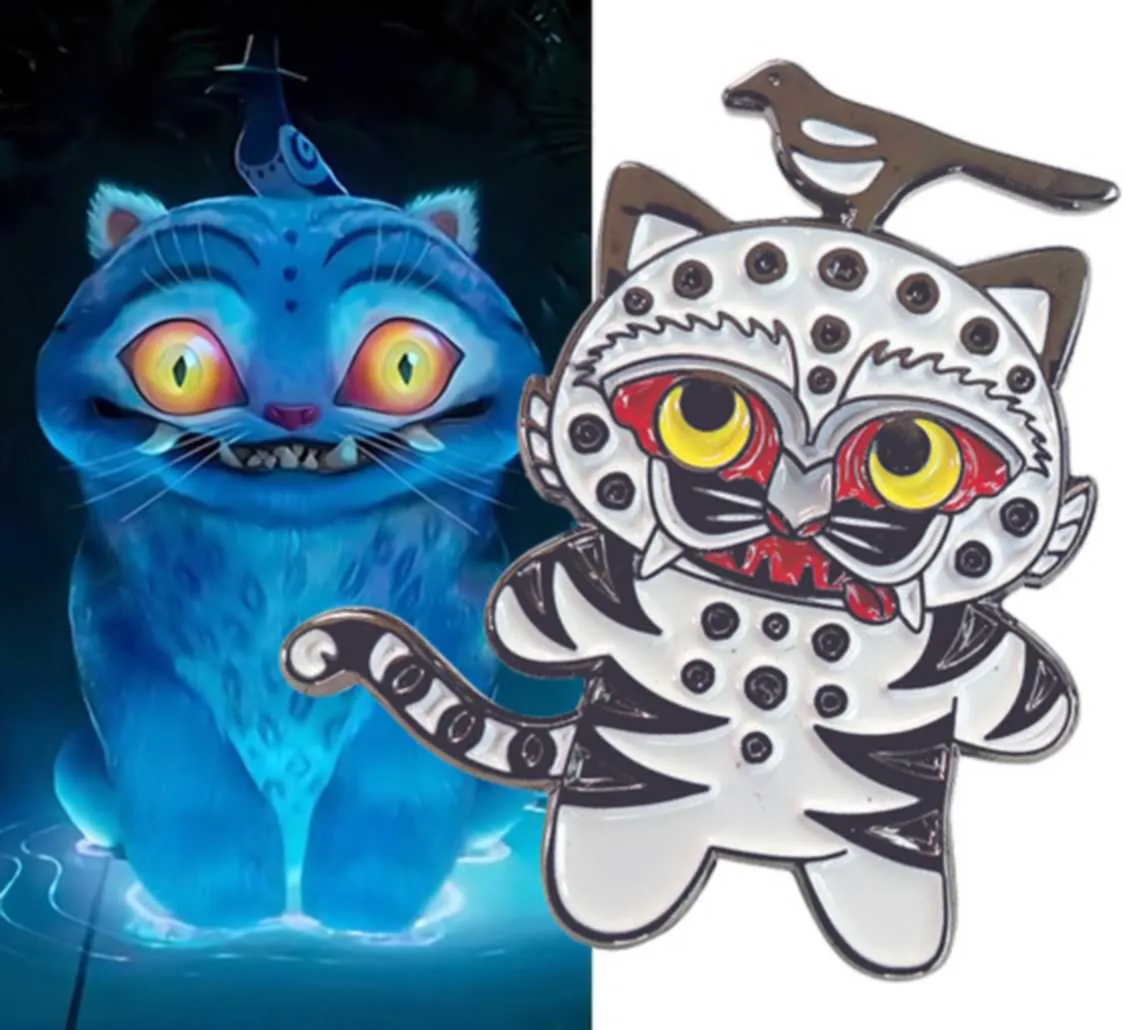
In 2025, the National Museum of Korea became the third most visited national museum globally, recording a historic 6.5 million visitors, following only the Louvre in Paris and the Vatican Museums in Rome. The surge in merchandise sales at the National Museum of Korea””despite having no direct affiliation with Netflix””following the release of K-pop Demon Hunters points to a broader desire to possess a tangible fragment of what is otherwise a digital cultural experience. Long queues prior to opening hours””locally referred to as an “open run”””reflected heightened demand for museum merchandise. That year, the museum store generated 57 billion won (approximately USD 387 million) in sales, nearly tripling its revenue from the previous year. Merchandise-designed products also gained the colloquial label MU:DS, short for museum goods and read “myutjeu,” signaling the growing commodification of cultural heritage through retail practices. Visual parallels between the museum’s tiger-and-magpie badges””derived from minhwa (traditional Korean folk painting)””and the series’ animal characters, Derpy and Sussie, triggered a surge in demand, with over 90,000 units sold, with multiple reorders, ultimately making them the museum store’s top-selling item of the year. Although the tiger-and-magpie motif minhwa has long been part of the museum’s permanent exhibition, the global circulation of K-pop Demon Hunters dramatically amplified public interest in Korean traditional art and related museum merchandise.
Notably, K-pop Demon Hunters is a U.S. produced animation, produced by Sony Pictures Animation and distributed by Netflix. Yet its detailed incorporation of Korean cultural heritage, including traditional art, fashion, architecture, and landscapes, lends the series a sense of cultural legitimacy and Korean authenticity that facilitates the global commodification of Korean heritage. For global audiences, this traditionalist aesthetics operates as both cultural differentiation and market strategy, revitalizing interest in traditional Korean heritage.
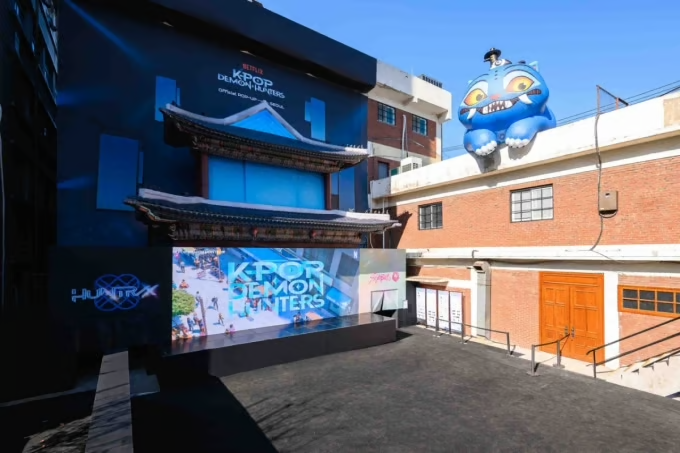
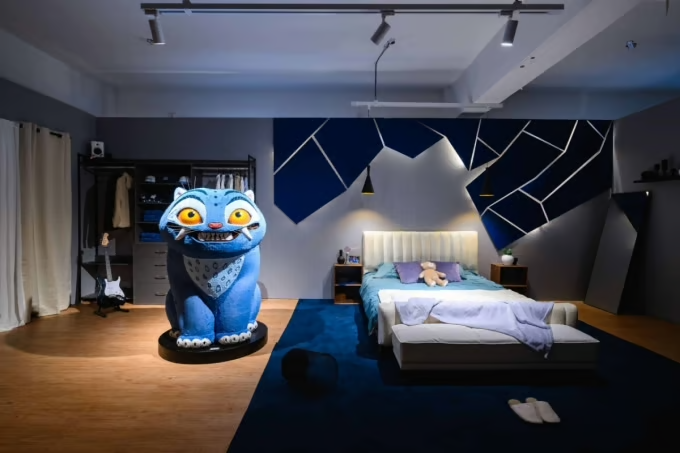
Netflix also hosted several official immersive marketing events. Similar to my previous Flow piece on dystopian immersive experiences at Everland, K-pop Demon Hunters featured a themed immersive zone at Everland that ran through the end of the year. As that installation concluded, Netflix launched immersive pop-up stores across Asia in seven cities, beginning in Seoul in December 2025. Housed in a three-story building designed in hanok (traditional Korean architectural) style, the initial pop-up store launched in Seongsu, Korea was organized into themed rooms that recreated sets from the series and displayed character mannequins for photo opportunities. The space also exhibited Huntrix and Saja Boys light sticks and digital wall art installations designed for photography. Several rooms offered interactive activities, such as drawing on hands with neon pens to simulate becoming “half demon” in a darkened room and searching for Derpy’s footprints in Huntrix Rumi’s room. The final section functioned as a retail space selling exclusive merchandise, including of plush toys and apparel. This offline experience was encouraged to post on social media using the event hashtag to receive a Derpy balloon upon exit. The tangible spatialization of an animated series through hanok-inspired architecture produced an immersive environment that encouraged user-generated digital content, extending the series’ visibility through participatory media practices.
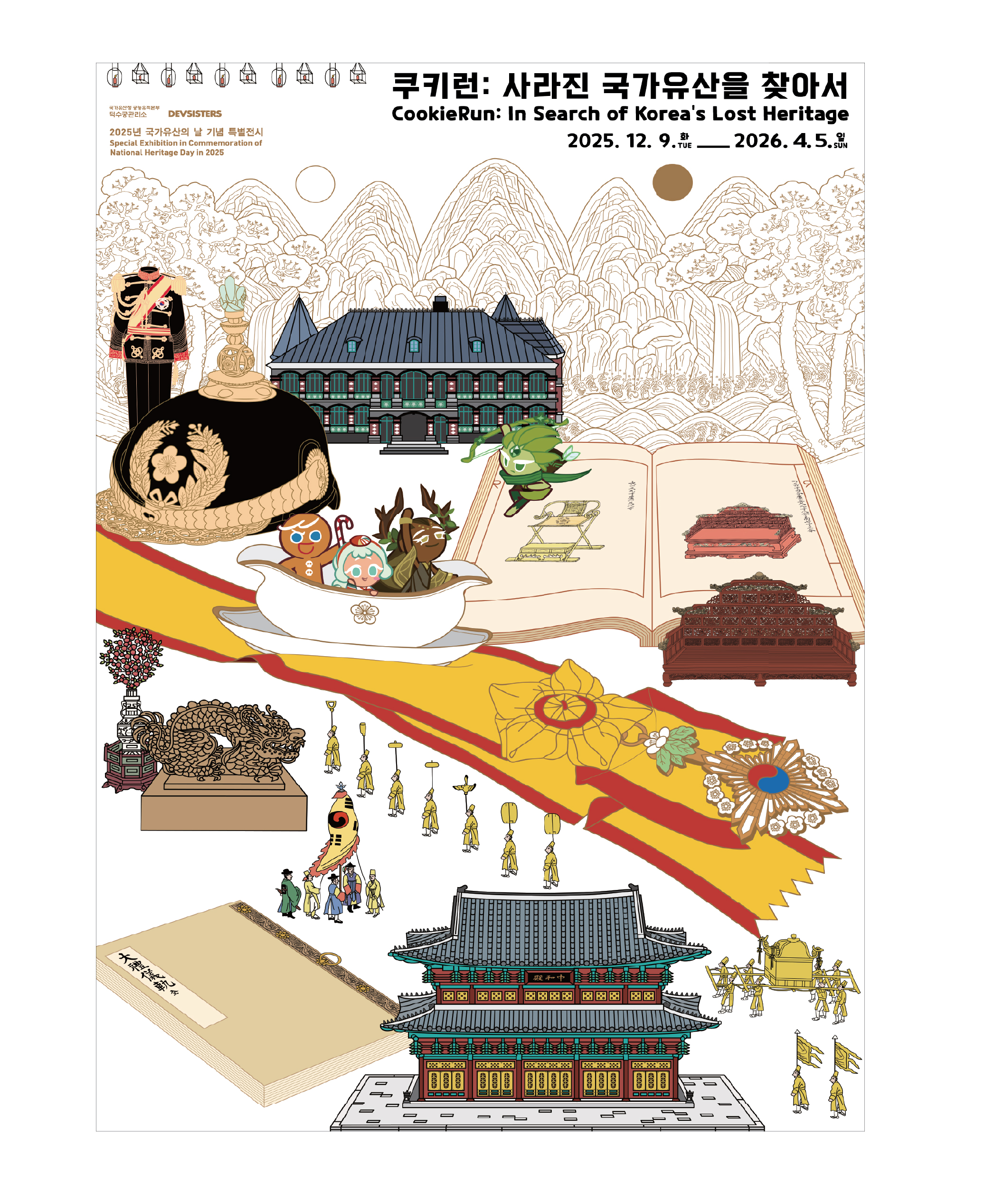
Also in December, Devsisters””the company behind the mobile game Cookie Run ””collaborated with the Korea Heritage Service to host the event Cookie Run: In Search of Korea’s Lost Heritage at Dondeokjeon Hall in Deoksugung Palace. Dondeokjeon Hall, which was destroyed during the Japanese colonial period was reconstructed to its original form in 2023, nearly a century after its destruction. Within Dondeokjeon Hall, alongside exhibitions of historical artifacts from the short lived Korean Empire (1897-1910, the final years of the Joseon Dynasty prior to Japan’s colonization of Korea)”” including imperial attire, furnishings, and photographs of the final two emperors of the Joseon Dynasty””Cookie Run‘s multi-character universe was integrated into the heritage space. An LED wall installation titled “Light of Unfading Hope” reimagined Seoul as it might have appeared had it never experienced Japanese colonial occupation. For the exhibition, National Intangible Cultural Heritage master craftspeople produced traditional cultural objects reinterpreted through Cookie Run characters: folding fans (seonja) painted with Wind Archer Cookie, chime instruments (pyeongyeong) engraved with Ginger Brave Cookie, and decorative knotting (maedeup) inspired by the color motifs of the Okchun Cookie, all crafted using traditional techniques. In an immersive digital art room in which screens enveloped the walls, floor, and ceiling, the spirit of the 600-year-old natural monument Jeongipumsong Pine Tree – historically known for raising its branches to allow King Sejo’s royal procession to pass – was revived through the character Millennial Tree Cookie.
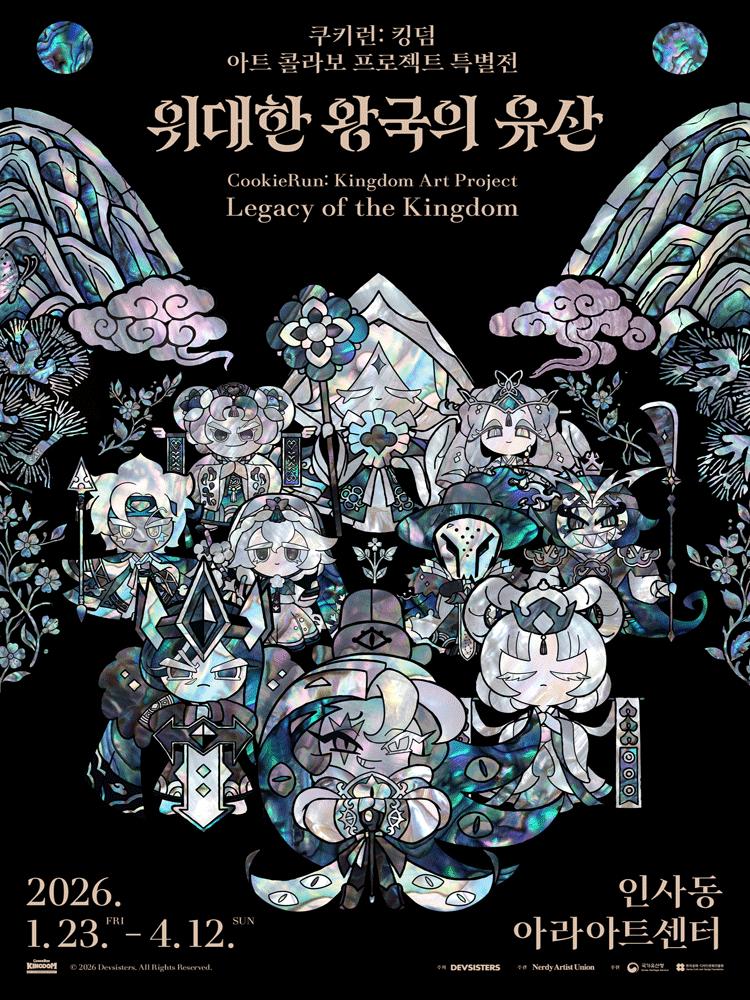
From January to March 2026, a subsequent exhibition, Cookie Run: Kingdom Art Project – Legacy of the Kingdom further expanded these collaborations with additional master craftspeople and a stronger emphases on art-based reinterpretations. Through these collaborations with the Korea’s Cultural Heritage Service and traditional artisans, Devsisters reimagines Korean history to include the digital multi-character universe, embedding the franchise within national heritage discourse. This strategy functions simultaneously as cultural heritage mediation and as a means of strengthening Cookie Run‘s Korean identity, intellectual property value, and global brand positioning.
Alongside the Korean Wave, media culture increasingly excavates and mobilizes Korea’s historical roots for incorporation into contemporary digitally borne media production. While much of K-culture – K-pop, K-drama, mobile games – seeks to operate as global brands and reach international audience, its strategy for differentiation relies on articulations of traditional Korean national identity. By drawing on cultural heritage within media texts as well as in offline, tangible promotional spaces, these industries legitimize their products as distinctly Korean and foreground their cultural specificity and uniqueness.
Image Credits:
- Top: People line up for an ‘open run’ at the National Museum of Korea on August 3, 2025; Bottom: The National Museum of Korea’s “Magpie and Tiger Badge.”
- Top: K-pop Demon Hunters Pop-up Store at Seongsu, Korea; Bottom: Recreation of Rumi’s bedroom in the pop-up store.
- Promotional posters for Cookie Run × Korean heritage collaboration projects.
The image of people lining up for an ‘open run’ at the National Museum of Korea perfectly illustrates the commodified spatialization of heritage.
I find this article particularly insightful in how it traces the increasingly blurred boundary between cultural heritage, digital media IP, and consumer experience.
Excellent analysis! It insightfully reveals how digital IPs amplify Korean soft power by spatializing heritage, blending tradition with modernity in innovative ways.
This article discusses how heritage is being represented in digital K-culture through spatialization. It’s fascinating to consider the implications for cultural preservation and accessibility.
This article explores how digital technologies are reshaping the preservation and accessibility of cultural heritage. It highlights the evolving relationship between tradition and innovation.
This article explores how traditional cultural heritage is being reimagined and presented in the digital realm. The commodification aspect raises interesting questions about preservation versus accessibility.
This article explores how digital technologies are reshaping our understanding and preservation of cultural heritage, particularly within the context of K-Culture. It’s fascinating how spatialization plays a role in this evolution.
This article discusses how digital technologies are reshaping the preservation and experience of cultural heritage. It’s interesting to consider the implications for accessibility and understanding of historical sites.
The content at this page is worth reading. I really enjoyed it a lot. Keep sharing such stuff. I highly appreciate it.
The idea of commodified spatialization helps explain how digital K-culture turns heritage into something audiences can imagine visiting and consuming. I found the connection between mediated place and travel desire particularly useful.
Except the first one all the other images are seemed to be ai generated or from extracted from a game. But all is well that ends well. I really enjoyed the whole stuff at this page.
The museum badge example and the Cookie Run exhibition seem to involve different routes into heritage: one begins with a visual resemblance outside an official partnership, while the other is a collaboration with named craftspeople. Keeping those routes separate could help show whose interpretive authority is involved in each case. For the Cookie Run displays, were the artisans and their techniques identified alongside the characters? That detail would help assess whether visitors could follow the franchise imagery back to the craft itself.