When Hallyu Meets Anti-Hallyu
Ji-Hyun Ahn / University of Washington Tacoma

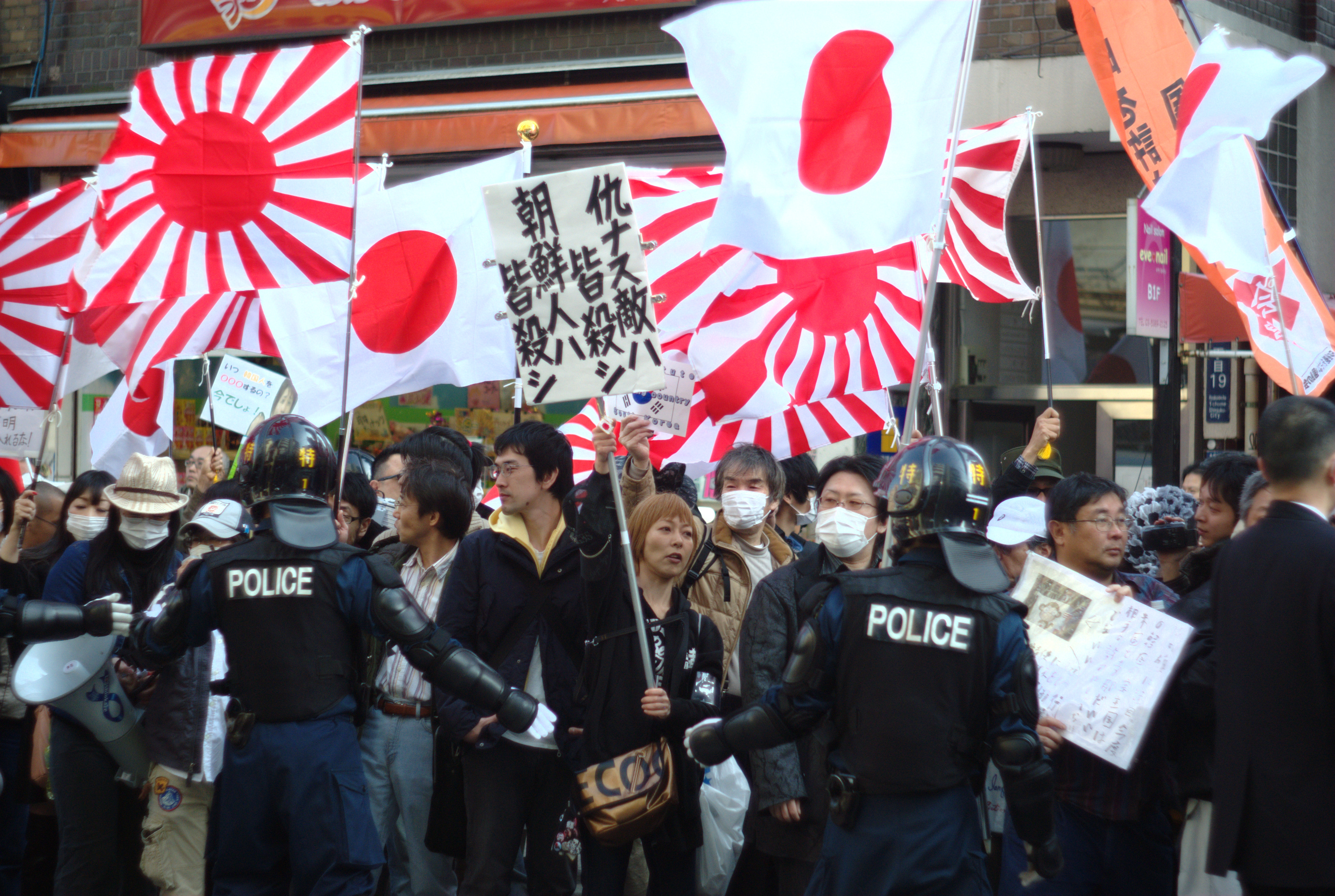
However, even as Hallyu has become increasingly ubiquitous and successful in the global cultural landscape, a seemingly opposite phenomenon has emerged in the form of a backlash against Korea and Korean popular culture. It is no coincidence that anti-Hallyu sentiment is equally on the rise, particularly in Asia, where the phenomenon originated and has already achieved saturation. In Japan, anti-Korean hate speech has been a serious social issue for over a decade, often manifesting in street protests by far-right groups; in China, anti-Hallyu movements and boycotting Korean brands have been frequently weaponized under the party-state regime, most notably seen in the 2017 “Lotte boycott” and the unofficial cultural bans following the THAAD missile defense deployment; in the Philippines, the #CancelKorea hashtag movement occurred in response to some Korean netizens’ racist comments on a Filipino influencer’s tattoo. Together, these incidents demonstrate varying degrees of anti-Korean sentiment and movements across North and Southeast Asia with differing geopolitical triggers and socio-historical motivations.
In this context, I argue that the variation in anti-Hallyu sentiment across the region deserves serious attention in order to advance critical dialogue about Hallyu and questions that scholars are struggling to answer about the simultaneous admiration and resentment it has provoked. While working on my current book project, which explores anti-Korean sentiment in postcolonial East Asia over the past decade, I have come to view the contemporary anti-Hallyu backlash not simply as nationalist reactions or regional cultural protectionism. Rather, I insist that it needs to be approached as what might be called the “post-Hallyu disjuncture” produced by subimperial displacement within an unequal global cultural hierarchy. Anti-Hallyu discourse often expresses resentment toward Korea, not because the country is a stable imperial center, but because its rising visibility has unsettled the established global cultural regime, which simultaneously privileges and challenges Western cultural authority. Put differently, the anti-Hallyu discourse critiques and, at the same time, reproduces colonial hierarchies, thereby projecting the growing social anxieties about national and global inequality onto Korea as a proximate and newly identifiable target.
Particularly revealing in the anti-Hallyu rhetoric is the fact that it often takes the form of complaints about overexposure to Korean popular culture and accusations of cultural ownership. Examples of this rhetoric include statements such as “Why is everything Korean now?” “It’s too global,” “It’s not original,” and “It borrows cultural items from others without credit.” This criticism does not necessarily involve the complete rejection of Korean popular culture but, rather, expresses a certain level of discomfort with what is perceived to be an inescapable presence. The notion that Korean popular culture is “too global” often implies that its current popularity is undeserved or unearned and, thus, points to the deeper contradiction that global cultural legitimacy is granted only conditionally.
These considerations call attention to the fact that the global success of Korean popular culture is only affirmed and praised when it passes through a series of familiar mechanisms of validation, such as global streaming rights, Anglophone media coverage, international charts, and the awards circuits, where “world-class” status is conferred through recognition by Western institutions. By contrast, when Korean popular culture appears to claim cultural authority on its own terms, it is perceived as excessive and culturally arrogant. This disjuncture is particularly evident in the anti-Hallyu discourse in which the notion of cultural hybridity is often framed as evidence of Korea’s inability to produce “truly” original cultural products, maintaining a hierarchical view of global culture that places Western influences above Korean creativity.

In this context, cultural hybridity is perceived differently, and it functions as a double-edged sword. On the one hand, the cultural hybridity of the Korean Wave is celebrated for fostering artistic innovation and creativity and offering a compelling alternative to Western-centric cultural narratives. On the other hand, critics””both within and outside the anti-Hallyu forces””have frequently responded to this hybridity with skepticism based on the accusations of cultural plagiarism, appropriation, and lack of originality. This ambivalence recalls the colonial logic of mimicry, in which the colonized subject is desirable when it is “almost the same” but becomes threatening when the similarity approaches parity (Bhabha, 1994). Thus, Korean popular culture is welcomed as a global phenomenon provided that it does not appear capable of overturning global cultural hierarchies. The charge of being “too global” thus functions less as an empirical description than as a boundary-setting device for reasserting entitlement to define the terms of global popular culture and, thereby, what remains derivative and provincial. Put differently, non-Western pop can be welcomed as “global” only when it performs globality in ways that reinforce Western cultural authority.
I also want to emphasize that the anti-Hallyu discourses that are articulated through these languages and logics participate, often unintentionally, in the maintenance of colonial conditions of global cultural hierarchy. Even when expressed as local resentment or regional rivalry, critiques that delegitimize Korean popular culture because it is not remaining in its presumed place tend to reaffirm the assumption that genuine global cultural authority must still be judged and affirmed elsewhere, implicitly by Western standards. In this sense, the anti-Hallyu discourses have the potential to reproduce the very hierarchies that they appear to contest by redirecting dissatisfaction with global inequality toward a proximate cultural actor and away from the structural conditions that continue to govern cultural recognition. Hence, the decolonization of Hallyu depends on recognition of Korea’s ambiguous status as a former colony that has evolved into a global cultural power. By examining this ambiguity, we can better understand the tensions within coloniality that the anti-Hallyu movements have encapsulated.
Image Credits:
- The poster of KPop Demon Hunters
- Image of protestors in Tokyo against ethnic Koreans
- NBC/Peacock advertisement for the Billboard Music Awards featuring BTS
Bhabha, H. (1994). The Location of Culture. Routledge.
Kim, Y. (Ed.). (2013). Korean Media Go Global. New York: Routledge.
Jin, D. Y. (2023). Theorizing the Korean Wave: Introduction to New Perspectives. International Journal of Communication, 17, 1-8.
Ryoo, W. (2009). Globalization, or the Logic of Cultural Hybridization: The Case of the Korean Wave. Asian Journal of Communication, 19(2), 137-151.
Shim, D. (2006). Hybridity and the rise of Korean popular culture in Asia. Media, Culture & Society, 28(1), 25-44.
Thussu, D. K. (2006). Media on the move”¯: global flow and contra-flow. London, UK: Routledge.
Yoon, K. (2017). Global Imagination of K-Pop: Pop Music Fans’ Lived Experiences of Cultural Hybridity. Popular Music and Society, 41(4), 1-17.
Notes:
What an insightful exploration of the Hallyu phenomenon and its counter-movements! I loved how you highlighted both sides. How do you think social media influences these dynamics today?
This was a fascinating read. I really appreciate how the article goes beyond simply celebrating Hallyu and instead examines the complexities of its global success and the backlash that has emerged alongside it. The discussion of anti-Hallyu as part of broader cultural and historical dynamics offers a nuanced perspective that’s well worth considering.
I like the idea of Hallyu and anti-Hallyu existing at the same time instead of one replacing the other. It reminds me a bit of how fandoms can love the global polish of something while also pushing back against it — even mega man x regenesis feels like it would live in that weird space between hype and resistance.