Metagaming: Challenges and ROM Hacks in Early Pokemon Games
Thomas Cooper / University of Texas at Austin

Of all media franchises that “require no introduction,” Pokemon is perhaps one of the most deserving of this title. But this success has not translated into a squeaky-clean record with fans. Many have decried the company for their lack of altering the game’s standard formula or railed against it for lowering difficulty to maintain wide appeal. While the games have fostered large competitive-oriented communities that certainly demand high execution, literacy, and commitment, this may not fit within most people’s definition of what makes a Pokemon game attractive in the first place. Where is the sense of journey? Or the feeling of progression? Each playthrough of a Pokemon game presents a breadth of possibilities; its diversity of items, abilities, stats, and catchable creatures, all lead to a range of potentialities that have little overlap between players. But fans like myself have long histories with these titles; leading us to want more from our Pokemon experiences than the company seeks to offer. Rather than focus on any particular new title, spin-off, or success of the Pokemon intellectual property, I want to gesture towards a section of Pokemon fans that are making their own rules within the confines of the early Pokemon titles to create new levels of play.
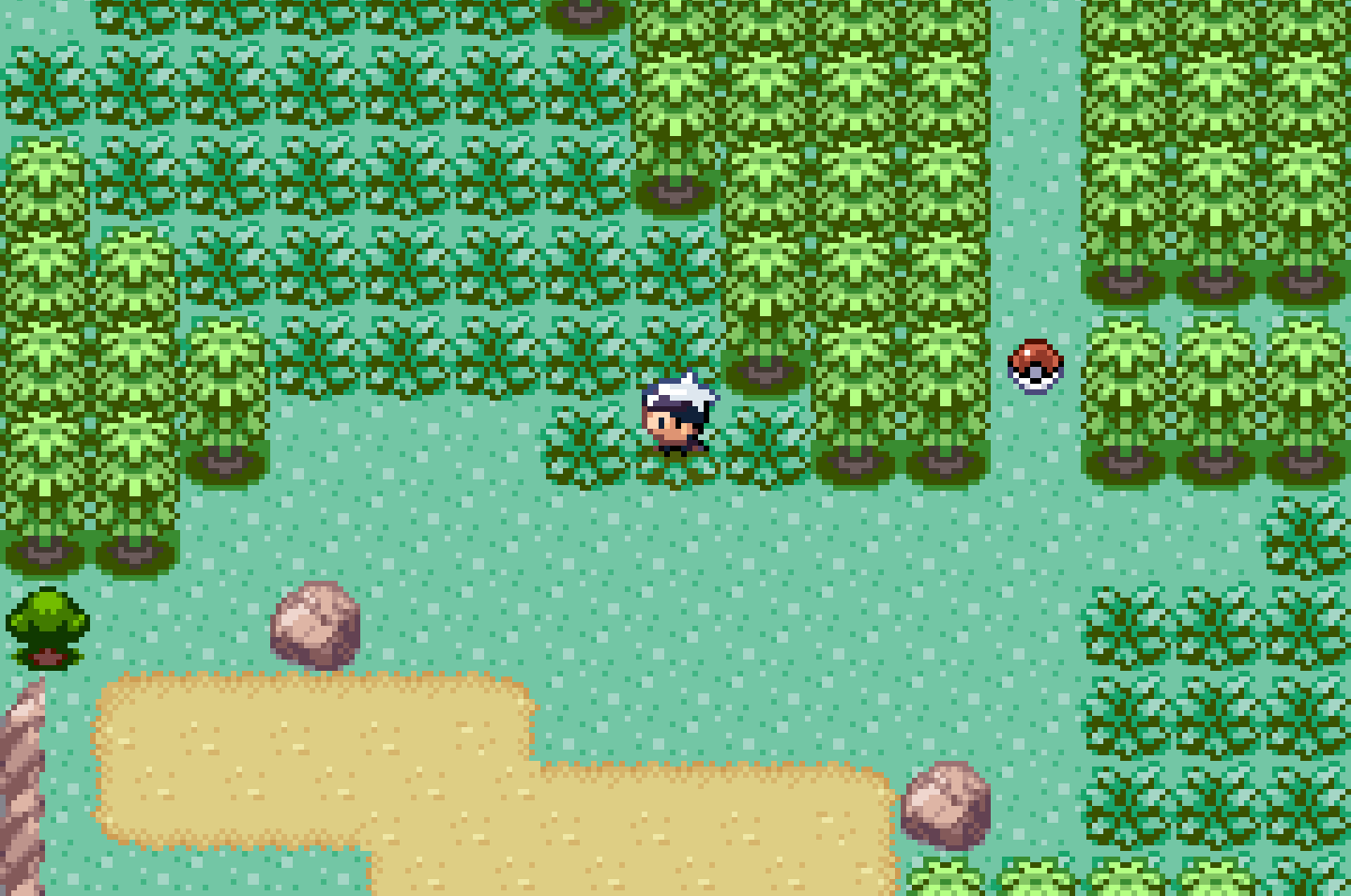
Early Pokemon features a top-down perspective, 2D-sprite style, and a linear map design of routes and corridors, caves and waterways, and points of interests such as towns or cities. Every route has a set list of Pokemon that can be encountered and a percentage rate at which they may appear while exploring the game’s tall grass or caves. Using the Pokemon you encounter along the way—as well as a few “gift” encounters, such as one of the game’s fire/water/grass starters—the goal of the game is to defeat 8 gym leaders in increasing difficulty and challenge the game’s champion. This formula persisted in the games for decades with additional quality of life, balancing, and mechanical changes occurring with every subsequent generation. And thus the early Pokemon title is unrecognizable to those who know of the series through its most recent entries. These early titles are compelling to fans because of their simplicity. The gameplay loop of travelling from town-to-town, building a team, and competing against non-playable character (NPC) trainers to further advance in the game’s region offers a legible sense of progression. But for those who have mastered an understanding of what the game has to offer, this gameplay loop suffers from its formulaicness, leading to the popularity of challenge runs such as “Nuzlockes.”
A “Nuzlocke” is a challenge where players abide by a series of self-imposed constraints. While the exact rules of a particular playthrough vary across the community, they generally include: not allowing healing items, removing any fainted Pokemon from your team’s roster for the remainder of the challenge, forbidding over-levelling your team past the next gym leader’s highest level Pokemon, and limiting Pokemon you can catch to only the first in every route. 1 Nuzlockes are focused on depriving the player of the fundamental mechanics that the game offers for player success: usage of items that raise stats, healing and reviving team members, grinding experience points, and catching ‘em all. The tenets of typical Pokemon stewardship are replaced to create a more difficult experience for the player in ways that diverge from the typical style of gameplay and create more diverse playthroughs than if the player were to choose only the best for their team. And if the player happens to lose their entire party during any of the game’s encounters, according to most people’s rule of Nuzlockes, they must restart their game from a new save file. While the game’s mechanics do not behold the player to any of these guidelines—they could easily continue with the game disregarding any of the Nuzlocke rules—abandoning the challenge is tantamount to a “game over.” Though Nuzlockes are completely voluntary and without the rigid constraints of video game mechanics, lending them to be considered a type of “metagame.”
As Boluk and Lemiuex write, “metagames are the games created with videogames,” they include speedruns, blind playthroughs, and other arbitrary challenges.2 Nuzlocke challenges fit within this concept of the metagame, with their primary mode of play being self-imposed constraints within the Pokemon title. But other challenges exist in Pokemon beyond Nuzlockes. Pokemon has become host for speedruns, single-Pokemon challenge runs, or playthroughs using only a single-type. Each of these challenges becomes a single possibility within the “software sandbox” of the Pokemon game. While these metagames adhere to the mechanics of the game as they are presented by the original developer, Game Freak, some fans have taken it upon themselves to usurp the role of developers through mods and hacks.
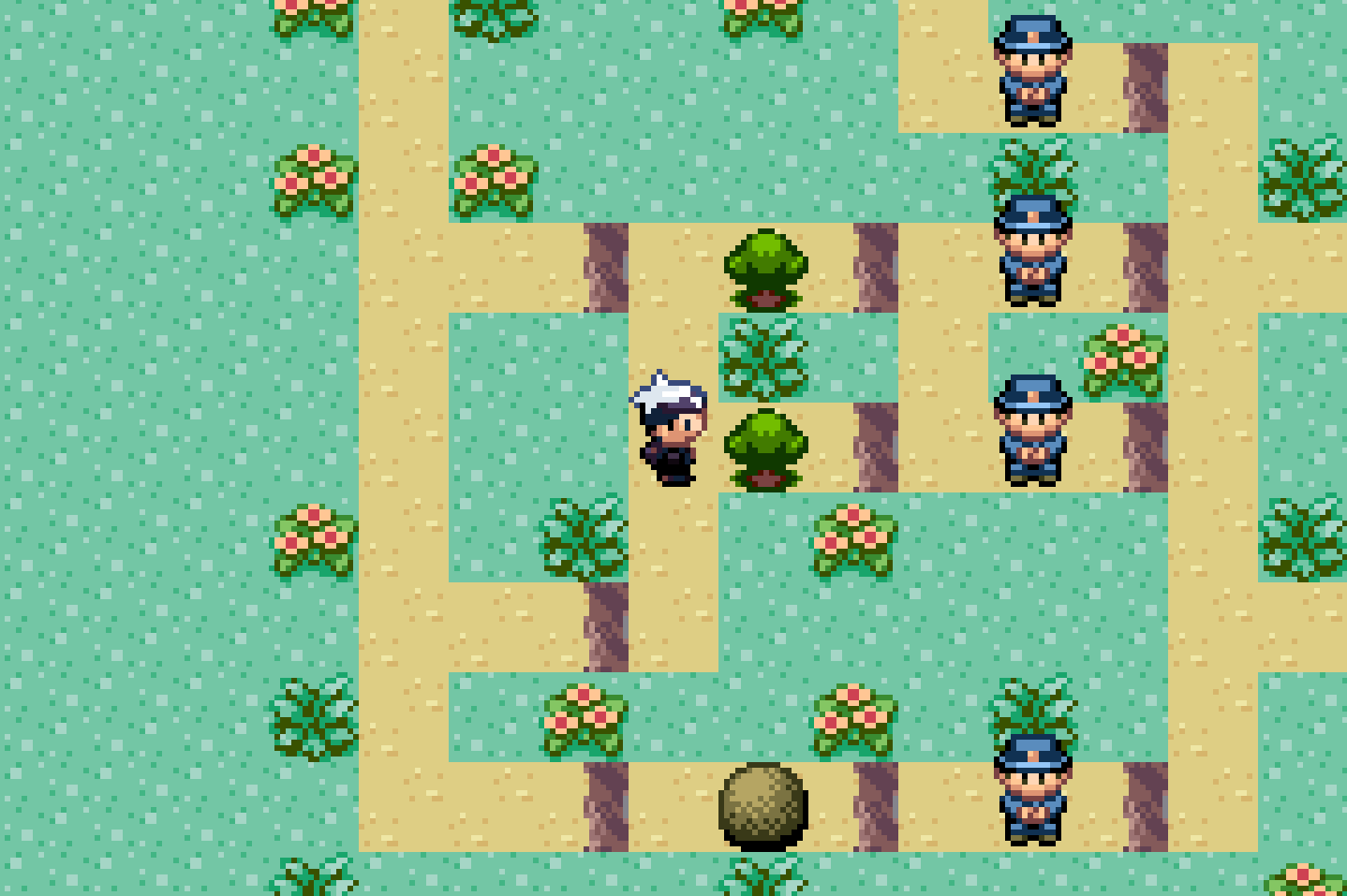
ROM hacks transform their base games by altering the Read-Only Memory to edit the game map, script, or Pokemon. Early Pokemon games——for the sake of simplification, I’ll be focusing on Pokemon Emerald (2004) on the Game Boy Advance—have become incredibly popular in the ROM hacking community due to the accessibility of modifying the game’s visual and digital content. Changes can be simplistic, such as implementing a “randomizer” that changes your encounters to any of the game’s potential Pokemon; or complete difficulty overhauls, such as Pokemon Run & Bun (2023), made by the competitive Pokemon player Dekzeh. Among the most popular of these ROM hacks is Pokemon Emerald Kaizo (2017), a difficulty hack that gives every trainer intricately designed teams and transforms the game into a brutal gauntlet for the most ardent of fans. Kaizo borrows its name from the 2007 mod Kaizo Mario World, also known as Asshole Mario, that is known for converting the Super Mario World game into a deliberately strenuous ordeal. The word “Kaizo” itself fittingly means “reconfigure,” or “modify,” as these games do not necessarily add anything new to the story or mechanics of the game, rather they restructure the existing obstacles, NPCs, and game elements to configure a new set of challenges. However, this is not always the case, as ROM hacks can completely shift games into new territories; such is the case of Pokemon Emerald Rogue (2024), which turns the RPG into a roguelike dungeon crawler. Each playthrough of Emerald Rogue navigates procedurally generated routes with random trainers, encounters, and gym leaders at the end of each dungeon with teams that change with every attempt. Each of these metagames is an attempt to break the seriality of the base Pokemon title,3 connecting audiences through their love of stretching the potential of the Pokemon game as a medium.
While ROM hacks are driven by a community need to diversify play in the games, they legally infringe on the ownership of the Pokemon intellectual property holders. After all, these games circulate through digital means—in online repositories, ROM hacking platforms, or through private communities—that Nintendo and the Pokemon Company do not have any oversight over. These ROM hacks, however, are protected due to a technicality: as long as they circulate as “patch” files (denoted by an extension such as .IPS), text files that hold modifications for the save of a particular game, rather than containing the executable game files (denoted by the extension .GBA). Patches are protected due to them holding no actual copyrighted content and simply serving as a guide for the data within the game files. The standard, legal and ethical practice for those wanting to play a ROM hack entails “dumping” or uploading the digital contents of one’s own Pokemon cartridge to their personal computer and using software to apply the patch file that they found online; from here, the player has a choice to continue on the original hardware or utilize legal emulation software that mimics the function of its original device.
Regardless of how one chooses to play these games; hacked, modified, or in its base form, this line of inquiry allows for a more in-depth understanding of how “participatory communities” are shaped by gaming platforms in their afterlives.4 These metagames exist beyond the intellectual property of the Pokemon Company and within the domain of the end-user, whose vast knowledge of the Pokemon franchise fuels their creation. As Apperley and Parikka5 argue, and Custodio6 makes evident in her analysis of the Fire Emblem GBA ROM Hack, the study of video game platforms has the potential to evoke the “memories and experiences” of the end-user. through the use of paratexts and unofficial productions. Nuzlockes and ROM hacks teach us that while the mechanics of a video game may present a particular way to play, the medium’s affordances offer numerous ways to bend, stretch, or destroy its mechanics to offer more satisfying and disparate engagement between fans.
Image Credits:
- A photo of the cartridge of Pokemon Emerald and its original hardware platform the Game Boy Advance.
- The standard gameplay of an early Pokemon game includes a linear progression of routes the player explores in order to progress. Here they may find new items, team members, or challenges as they proceed in the game’s story. (author’s screen grab)
- In Pokemon Emerald Rogue, the typical route design is replaced by a set of paths that the player chooses in a new overworld. These paths have procedurally generated challenges that change every attempt. (author’s screen grab)
- https://bulbapedia.bulbagarden.net/wiki/Nuzlocke_Challenge ↩︎
- Boluk, Stephanie, and Patrick LeMieux. 2017. Metagaming?: Playing, Competing, Spectating, Cheating, Trading, Making, and Breaking Videogames / Stephanie Boluk and Patrick LeMieux. Minneapolis, Minnesota?; University of Minnesota Press. ↩︎
- Ibid. ↩︎
- Custodio, Alex. 2020. Who Are You??: Nintendo’s Game Boy Advance Platform / Alex Custodio. Cambridge, Massachusetts: The MIT Press. ↩︎
- Apperley, Thomas, and Jussi Parikka. 2018. “Platform Studies’ Epistemic Threshold.” Games and Culture 13 (4). Los Angeles, CA: SAGE Publications: 349–69. doi:10.1177/1555412015616509 ↩︎
- Custodio, Alex. 2020. Who Are You??: Nintendo’s Game Boy Advance Platform. ↩︎
I found the discussion of participatory gaming communities interesting, especially the idea that players can reshape a game through challenges, ROM hacks, and other fan-made creations. It shows how a game’s original mechanics can become a starting point rather than a strict limit
Really enjoyed this piece! It hits the nail on the head regarding why so many of us turned to Nuzlockes and ROM hacks like Emerald Rogue. Once the official games start feeling a bit too predictable, the community’s creativity is honestly what keeps the magic alive.
The discussion of ROM hacks as responses to Pokémon’s increasingly softened difficulty is especially compelling, since it frames metagaming as both a critique of the standard formula and a form of fan-led experimentation. Connecting those hacks to the Game Boy Advance’s original hardware also highlights how technical limitations shaped the possibilities of play.
The discussion of metagaming and ROM hacks shows how players have actively reshaped early Pokémon’s constraints rather than simply accepting the standard formula. I especially liked the connection between original Game Boy Advance hardware and fan frustration over reduced difficulty.
The distinction between a Nuzlocke and a ROM hack is especially useful here. A Nuzlocke changes the player’s commitments while leaving the software intact; Emerald Rogue changes the routes and encounters themselves. Both can make a familiar game feel uncertain again, but they give players different kinds of authorship. I wonder whether smaller tools that let people design and test their own puzzle layouts belong somewhere between those examples: they change the challenge without rewriting the game’s underlying rules. That middle ground seems worth exploring in the discussion of metagaming.