”IN THIS ESSAY I WILL…”: ON OWNING IDEAS LAUREN MCLEOD CRAMER/ UNIVERSITY OF TORONTO
Lauren McLeod Cramer/ University of Toronto
The end of the semester is the time for reflection, an ideal moment to be reminded of the higher aspirations of higher education. Indeed, this is the ‘stuff’ of good commencement speeches that are, for the university in crisis, often a final opportunity to make the case for higher ed. We hope to prove the lessons learned in a seminar are life-altering and lasting and, thus, more profound than the whims of shifting job markets. As such, I find myself scouring popular media (my object of study) to see traces of myself: academic jargon in the wild, the faint appearance of a five-paragraph essay organizing a YouTube video, or careful citationin a podcast episode. Here, despite mounting skepticism about the value of a university education, I am heartened by what appears to be, the undeniable pleasures of the classroom.
Recently, I tried to share this source of optimism with a friend and fellow university professor who was lamenting the decline of cultural criticism in popular publications. To assuage his concerns, I told him that public thinking about arts and culture still exists; it simply moved online. Understandably, he wanted to know how good this criticism is, given the algorithmic preference for “hot takes.” So, in defense of the intellectual work done on TikTok, I pointed to the similarities between the written essay and its short form videographic counterpart. These videos have boldly stated thesis statements that are supported by unique observations and compelling analyses. In fact, the approach is so similar that it isn’t uncommon to hear a TikTok cultural critic signal their academic formation by beginning or captioning a video with familiar phrases like, “In this essay I will…”
@aclosei I want to get my doctorate in Zillenial Cyber Colloqial Anthropology #yapsession #inthisessayiwill ? original sound – AFARI
I remain resolute in my support for what we might call TikTok criticism and, yet there are logical flaws in my own argumentation: when asked if online discourse about art and culture is “good,” I pointed to the academic-inflected meme and said, “see, they do it just like us.” It is fair to argue that contemplative critical work, the kind that supports an ongoing relationship between a thinker and their audience that are both open to change and willing to revise ideas, is not served by the market pressures that produce most online content. Yet, it is patently false to suggest the same conditions are not present in traditional scholarship. our arguments “hot takes,” but as the contributors and readers of Flow know, we do experience the pressure and desire to ‘keep up’ with the pace of the contemporary media that inspires us. Speed is an aspiration shared by the affiliated and unaffiliated scholar because, as the previous video explains, the phrase “in this essay I will” is claim to ownership. I get it and I got here first!
Among the many reasons why applying this property logic to ideas is an obvious problem is the way it belies the communal contexts in which “new” concepts are actually made. The sole claim of the single-author is a fiction that inadvertently reduces scholarly thought to a performance, as if a discrete observation about the world is, by sleight of hand, transformed into an “important” claim by simply whispering a few magic words. In this essay I will… This is, of course, a particularly bad idea in a climate of distrust in the university and the value of an education in the humanities. Still, we often equate thinking with proprietary acts (“making a claim” or “laying out the stakes”) because, as Stephano Harney and Fred Moten explain, this is the role of the “critical academic.”1 The professional scholar, in their commitment to the institutionalization of study, is an assessor of ‘proper’ and ‘improper’ ideas—not unlike my flawed comparison of traditional and TikTok criticism. Indeed, in the act of coining terms there is a fundamentally conservative impulse to end the discussion (it is not a coincidence that “owning the libs” is often the aim of the most distracting and obstructionist political statements). So, while there is no question that platforms like TikTok or X (Twitter) incentivize a structure of exploitation that demands a consistent output of novel (preferably incendiary) ideas, who taught its most distinguished content creators how to do this?
Reduced to a performance, of course scholarly thought becomes a site (cite) of privileged extraction. Thus, while the merits of specific online opinions are worth discussing, they cannot be divorced from the issue of form. “In this essay I will” separates the ideas that do and do not belong. All arguments are meant to be adopted and circulated; as such, the difference between proper and improper argumentation really is an expression of value(s). A claim becomes valuable, in a citational sense, by charging for its use. On the other hand, the crude form of a thought—the idea prior to any alchemic academic process—doesn’t belong to anyone so it requires another mode of evaluation. The crude form might constitute what Harney calls a concept, an idea measured only by its ability to bring people together.2 Enacted earnestly or as a spoof, a “take” is always appropriative, but this distinction necessarily changes my friend’s question (“is TikTok cultural criticism any good?”) and my response (“they do it just like us”). Using a different rubric, one that isn’t an expression of anxiety about the future of the institution, I can make a proper case for TikTok criticism and the popular use (or misuse) of scholarly forms.
At the beginning of this essay I pointed to Jack Harlow’s academic interests to prove that, despite the reported cynicism surrounding college, in popular culture we can see a desire, not just to learn, but to experience guided instruction in a space reserved for the ongoing process of thinking.3
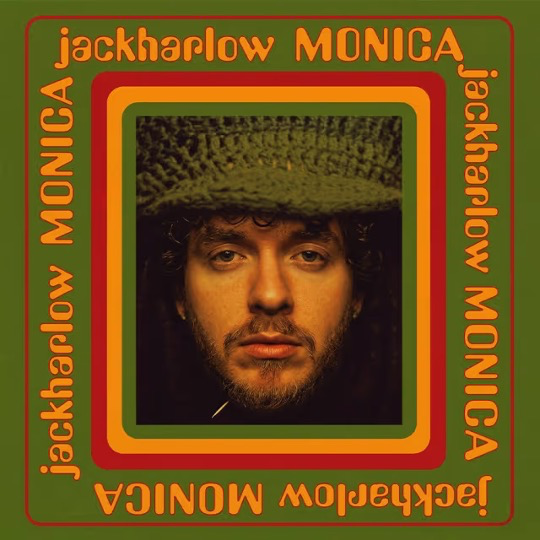
Admittedly, I only know this about Harlow’s interest in classic cinema and hard-to-find books (what he calls a process of “obsessive self-enhancement”) because this podcast interview recently went viral. Prior to this moment in the episode, Harlow tells the interviewers that, in making his new album Monica (2026), he “got blacker.” While there’s no denying this statement is strange and, taken at face value, demonstrably false, the clip received considerable attention online, mostly from critics pointing out Harlow’s problematic cultural appropriation. Following the hype, I watched the episode and found the egregious moment underwhelming: Harlow and reporter Joe Coscarelli are momentarily talking over each other; Harlow is clearly trying to simplify a place that Coscarelli and co-host Jon Caramanica were leading the conversation over the previous several minutes; and, smiling at his interviewers, the rapper seems aware of the controversy this statement might cause. Thus, what I find interesting about some of the TikTok criticism that followed was the need to take some creative license with the conversation to make this mini-controversy worth the watch (the nine-second clip plus the accompanying treatises on American race relations that were significantly longer). As such, at no point was being “right” or “wrong” about the meaning of Harlow’s statement the priority of these think pieces.
Instead, what characterized the different online responses to the clip were their relationships to the proprietary nature of the claim. The most “academic” criticism included cultural studies jargon and made historical references to abuses in the music industry, using these ideas to argue Harlow performed a problematic performance of cultural appropriation. Among the “academic” claims I saw, none observed the fundamental contradiction in an ownership claim made on the behalf of black culture (that this argument relies on the same property logics that exclude and degrade black art). Notably, TikTok’s more audacious criticism, the kind it did not learn in university classrooms, managed to avoid this problem. In the wake of Harlow’s gaffe, my feeds were flooded with images of classic R&B and rap albums, reimagined as the work of the “blacker” Harlow. While I could write an entire essay about how hilarious some of these images are, along with my concern about the speed in which a creative idea is given over to AI image generators, what’s important here is identifying their work as literal counterclaims. These images seriously considered the prospect of Harlow’s blackness and, through the illicit modification of each copyrighted image, the work finds the claim of cultural theft deeply unserious.
Good and bad arguments exist everywhere and while the differences between them are often disciplinarily specific and open for debate, the merit of an idea cannot hinge on accreditation or any other mode of exclusion. On the other hand, it does seem reasonable to evaluate an argument based on the quality of the conversations it produces. I sent Black Harlow memes to my friends and family””some who work in the academy and many who do not, and some who aren’t old enough to recall the neo-soul albums referenced in these memes (I do hope they’ll listen to this music to find out why the reimagined covers are so funny). Academics know it can be hard to encourage our students, colleagues, and communities to engage with scholarly materials. Thus, it is worth noting that these images might be the best-received scholarship I’ve sent to this intergenerational, extra-disciplinary “classroom.” I imagine we still have a lot to learn from our TikTok colleagues.
Image/Video Credits:
- The cover of Jack Harlow’s album Monica (2026)
- Look! Jack Harlow says he wishes he went to college! Jack Harlow on The New York Times Popcast, March 13, 2026.
- TikTok user @acloseiexplains the colloquial use of the phrase “In this essay I will.” February 20, 2026.
- A remix of Eryka Badu’s album Mama’s Gun (2000)
- Stefano Harney and Fred Moten, The Undercommons:Fugitive Planning & Black Study, Minor Compositions, 2013. ↩︎
- Harney and Moten, <em>The Undercommons</em>, 106. ↩︎
- Ben Kamisar, “Poll: In a dramatic shift, Americans no longer see four-year college degrees as worth the cost,” NBC News, November 28, 2025. https://www.nbcnews.com/politics/politics-news/poll-dramatic-shift-americans-no-longer-see-four-year-college-degrees-rcna243672. ↩︎
What a thought-provoking essay, Lauren! Your take on the importance of owning one’s ideas really resonates with me. I recently struggled to assert my own perspective in group projects but learned that sharing our unique insights fosters creativity and collaboration. It’s inspiring to see this highlighted here!
Came across this while researching — glad I did. Very informative.