The Long Shadow: The Ethics of True Crime Drama and the Texture of Local Space
Helen Piper / University of Bristol
Dramas “based on a true story” are ubiquitous in contemporary television. Through their opening declarations they claim a definitive interpretation of “truth” that is there to be found in actuality – they suggest that they are true precisely because they refer to actual events involving actual people in space and time. At best, such dramatizations can offer purchase on matters of public interest – making sense of that which is known to have occurred by bringing narrative order, emotional legibility, a new way of seeing. However, many recent shows stand accused of prurience, or – particularly if the subject is criminal – of exploiting private trauma for public amusement. In some well-documented instances, true story dramas prompt litigation – as did Baby Reindeer (Netflix, 2024) – although their ethical complexity is seldom given proper consideration amidst flurries of “public” outcry. Noting similar scandals in literary publishing, Donna Lee Brien regrets how often these have revolved only around the exposure of an “obvious untruth”, and that subsequent “discussion generally stalls at either backward-looking moral superiority or postmodernist explanations that all truth is relative.” 1
More useful, perhaps, is if these true stories could also be evaluated through their imaginative contribution, not least because dramatic storytelling should always be morally accountable. Admittedly, true story dramas carry additional responsibilities, particularly to the real people (victims, survivors, families, public figures, communities) whose lives are depicted. However, if debate is to get beyond merely sorting the literal from the invented, then a more holistic sense of ethical integrity is required. For this it will be necessary to pay careful attention to aesthetic choices – that is, to the manner of dramatic expression – as it is by such details that any presented interpretation (of truth) will be shaped. Using a recent fact-based crime drama, The Long Shadow (ITV, UK, 2023) by way of example, I would like to show how the careful and creative use of space and place helps the series to meet both dramatic and additional responsibilities, supporting its victim and survivor centricity.
The Long Shadow retells the protracted police search for Peter Sutcliffe, Britain’s most prolific serial killer, between 1975 and 1980. At the request of victims’ families the series was retitled so as not to include the tabloid soubriquet ”the Yorkshire Ripper.”2 This sensitivity contrasts with a previous Netflix documentary, luridly titled The Ripper (2020), about which survivors and families have complained publicly. It is also important to recognise that the regional communities wherein Sutcliffe’s crimes were committed still bear scars of association, exacerbated by decades of ghoulish “dark tourism” to murder sites in Leeds, Bradford and elsewhere.3
The Long Shadow adopts a linear narrative that sticks closely to documented timelines and the representation of actual named people, including all of Sutcliffe’s thirteen female murder victims. Each woman is given a story that begins in life – rather than with the discovery of her death – relating something of her aspirations, struggles, and family relationships before victimhood. As the drama progresses, these stories are intercut and developed in parallel with events in the ongoing police investigation. Amongst other things, what we learn about their private lives gives the lie to offensive distinctions – routinely made by the police – between “good time girls” and “innocent” victims.
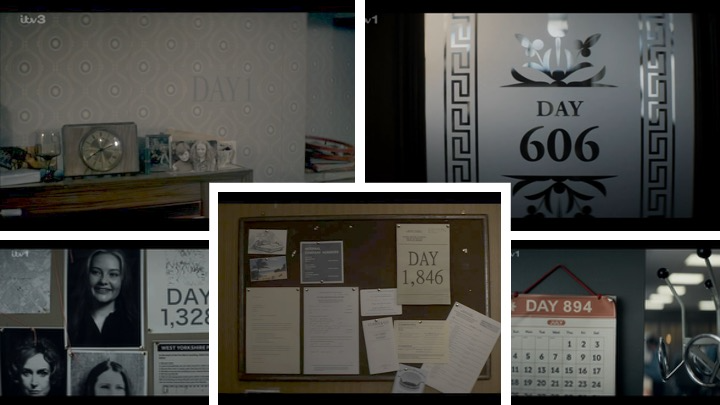
These mini biographical narratives depict the spaces and locations of Sutcliffe’s Yorkshire orbit as the familiar contexts of shared everyday life. There are no initial onscreen legends, no establishing or wide-angle shots of landmarks to spectacularise the region’s industry, urbanity or beauty. The viewer is not invited to survey the area from afar but to encounter it, closely-framed, at eye level, so as to appreciate the texture of the characters’ lived environments. Time is measured in days since the first murder, and new on-screen action is preceded by intertitles giving the latest tally, as if embedded in the material fabric of the diegetic spaces themselves (fig. 1).
At intervals in episode 2, three significant dates are introduced as days 84, 191 and 427, the numbers painted on the same red brick outbuilding on the edge of a public park (fig. 2).
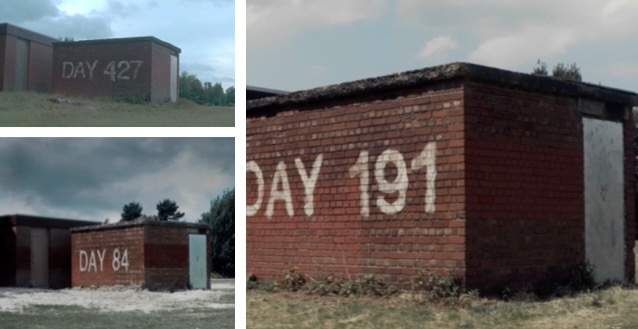
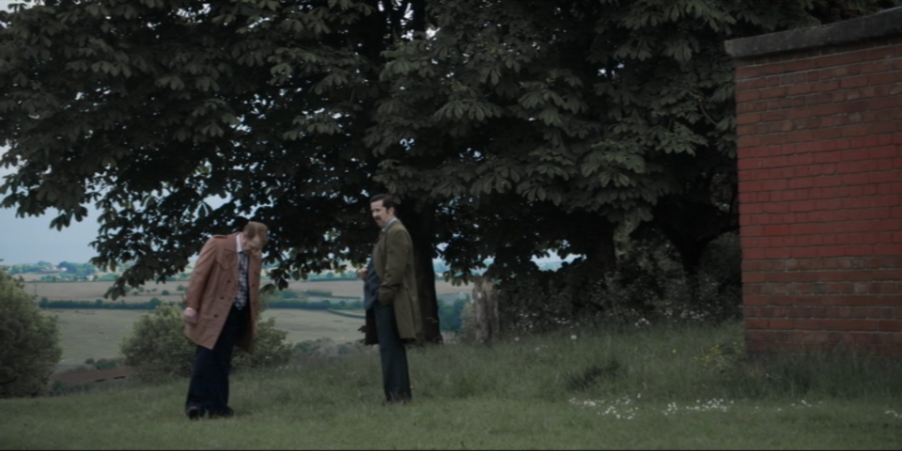
The images appear still but, on each occasion, are soon interrupted by the motion of a passing runner: a mobilisation that emphasises daily use of the space by the local community. Shortly after “Day 191” is announced, we cut to a police control room where a WPC takes an emergency call from a woman, Marcella, reporting a savage attack. Marcella had been left for dead in Roundhay Park but has managed, somehow, to make it to a phone box. For the viewer, the prior repetition of the park image immediately suggests that this new attack must be related to previous incidents (i.e. to “Day 84”), yet the police seem intent on ruling out any connection when they interview Marcella in hospital, developing a hypothesis at odds with her clear recollection of events. During a cursory visit to the crime scene, they surmise that as this is a known spot for soliciting, the attacker was probably Marcella’s pimp and not their serial killer. The visit is filmed using medium to long shots, dwarfing the two men (fig. 3) and exposing their minimal engagement with the space. Ignorant of the visual connection the viewer will have already made, the officers’ disinterest in the space itself clearly subverts the mythology of the fictional TV detective and the meticulous forensics of modern television crime scene analysis, critically exposing how these “actual” officers are manifestly unable to “see” the truth.
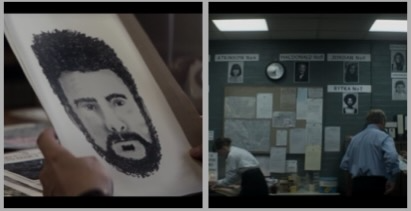
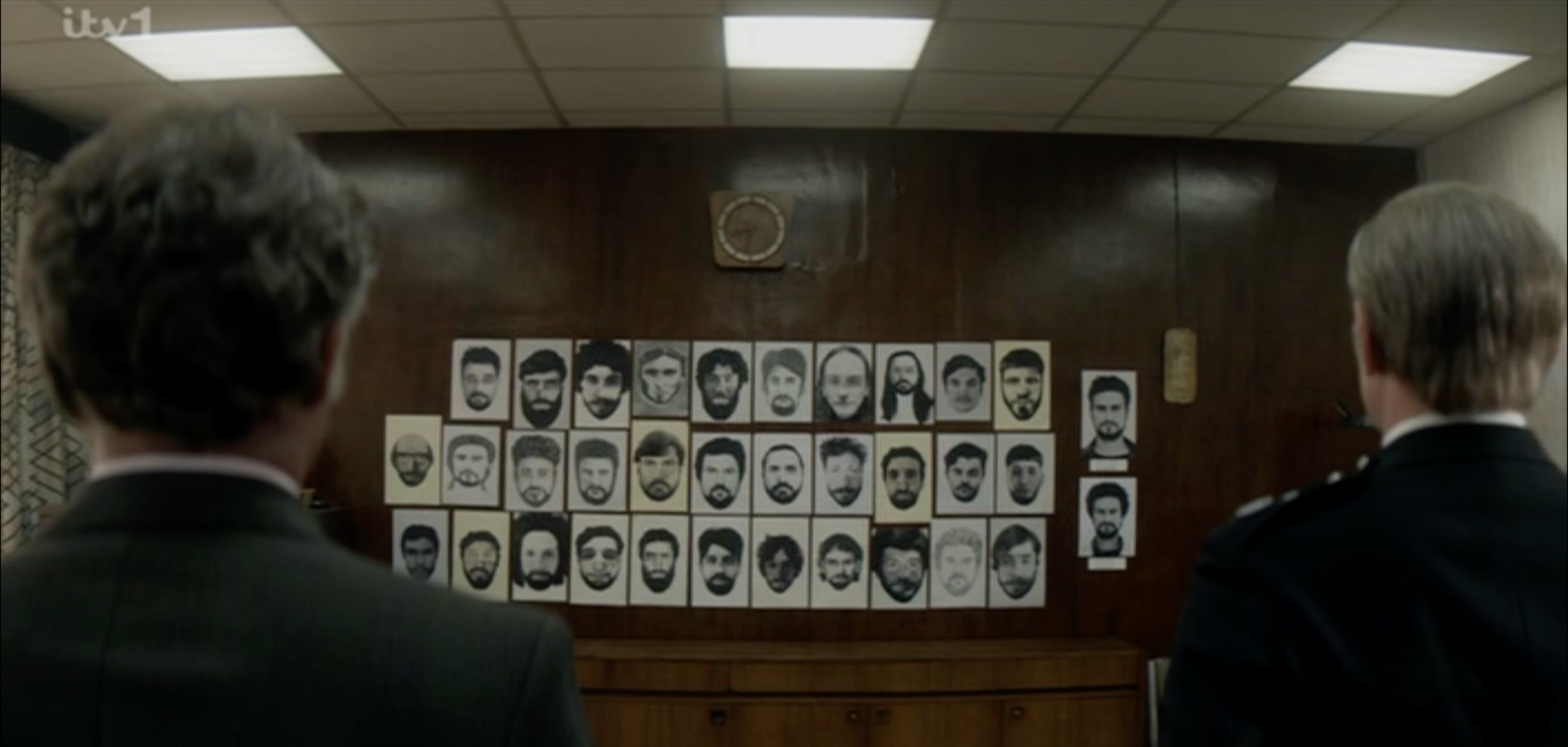
Later, on day 427, another jogger passes the very same spot in Roundhay Park, before noticing the body of a woman, a new victim later revealed to be Irene Richardson. The repetition of the park motif reinforces the viewer’s suspicion that the officers had made a catastrophic mistake by ruling out Marcella’s evidence. Nevertheless, they continue to do so, and the episode closes with DCS Hobson filing away the photofit image Marcella helped to produce of her assailant (fig. 4). Although she was thereby excluded from the police’s mapping of crime scenes, Marcella’s survivor story is returned to regularly in the television narrative, showing further injustices inflicted on her by both police and state. 4 After Sutcliffe’s eventual arrest in episode 7, there is a memorable moment that underlines the catastrophic nature of this early police failing, when Lawrence Byford, the senior officer reviewing the case, is invited to survey a wall of photofit images, many produced by survivors who were not believed, in telling comparison to two photographs of the apprehended perpetrator himself (fig. 5).
The iconic repetition of “Roundhay Park” in The Long Shadow is but one example of how attention is drawn to the relation between Sutcliffe’s horrific crimes and community life, and to the police’s misinterpretation of evidence. The banal, subjective materiality of local spaces also helps to make vivid the texture of women’s experience and the creeping, debilitating effects of their daily fear. After all, these are the same spaces in which the perpetrator moves, freely and routinely. By episode 6, when police are into their fourth, and then fifth year of hunting, they advise all women to “stay indoors,” thus turning the home into a space of involuntary confinement. Meanwhile, there are increasingly emphatic references to the likelihood that the police will already have questioned “the most wanted man of the century”, who must himself be “ordinary”, “forgettable.”
Whether or not factual drama is exploitative or legitimately in the public interest is often supposed to be an extra-aesthetic question, but clearly the answer (as to the myriad of other ethical questions raised by such works) is contingent on how a story is told. Rather than gratuitously sensationalising the “evil spree” of the serial killer (as “true crime” is so often wont to do), The Long Shadow conveys the lived experience of victims, survivors – indeed, of an entire region – whilst articulating a thoughtful critique of policing and the wider social attitudes that impeded enquiry.
Image Credits:
- Selected images of the cumulative day tally marked during the investigation, each number embedded in the material, diegetic world of The Long Shadow [compilation of author’s screengrabs].
- Three days are announced using the same park location (ep. 2) [compilation of author’s screengrabs].
- DC Nunn and DCS Hobson make a cursory visit to the scene of Marcella’s attack (ep. 2) [author’s screengrab].
- Marcella’s evidenced is filed away and she is omitted from the mapping of victims to crime scenes (ep. 2) [compilation of author’s screengrabs].
- Byford compares two photographs of Sutcliffe’s face (right) with photofit images accumulated during the investigation (ep. 7) [author’s screengrab].
- Donna Lee Brien, “Based on a True Story’: The problem of the perception of biographical truth in narratives based on real lives’, TEXT vol.13, no. 2., p. 1. ↩︎
- Of this decision, writer George Kay commented, “That name being attached to Peter Sutcliffe creates a dark brand around a man who doesn’t deserve that attention.” Cited by Craig Jones, “What Peter Sutcliffe’s victims’ families have said about ITV’s new drama The Long Shadow and name change plea”, Yorkshire Live, 25 Sep 2023. ↩︎
- So much so, in fact, that the very prospect of filming a TV drama about the hunt for Sutcliffe was greeted with alarm by Bradford City Council, who publicly withdrew their support for the filming of The Long Shadow. See “Peter Sutcliffe: Bradford council won’t back series ‘out of respect”, BBC News website, 6 Sep 2022. ↩︎
- Marcella’s survivor story is further omitted from The Ripper (Netflix, 2020). ↩︎
Thank you, Helen, for shedding light on the ethical complexities of true crime dramas. I often reflect on how my local community’s history shapes narratives—it’s fascinating yet troubling.
This piece deeply resonated with me; the ethical implications of true crime dramas often linger long after viewing. Our local spaces carry stories that can be overshadowed or exploited.
Thank you for such a thought-provoking piece, Helen. Your exploration of the ethical implications surrounding true crime dramas really resonates with me. It reminds me of how local spaces can hold deep narratives that deserve respect. I’ve often pondered this while using driving directions to navigate places steeped in history; it’s crucial we acknowledge their stories.
The discussion of opening declarations that claim a definitive “truth” is especially compelling, particularly when set against the ethical stakes of dramatizing real people and places. The focus on local space shows how true crime drama can transform ordinary landscapes into sites of spectacle, memory, and unresolved harm.